


Page 77 - LIMBA_1 MINISTRY_PROMO
P. 77
Note                                                                                    Do you like History?
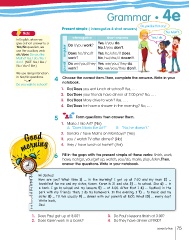
                            Present simple ( interrogative & short answers)
In English, when we
give a short answer to a                                                                                           No, I don’t.
Yes/No question, we
use the auxiliary verb                       interrogative   short answers           Yes, I do.
do/does. Do you like
Maths? Yes, I do./No, I     plural singular  Do I/you work?  Yes, I/you do.
don’t. (NOT: Yes, I like./                                   No, I/you don’t.
No, I don’t like.)
                                             Does he/she/it Yes, he/she/it does.
We use rising intonation
in Yes/No questions.                         work?           No, he/she/it doesn’t.

Do you walk to school?                       Do we/you/they Yes, we/you/they do.

                                             work?           No, we/you/they don’t.

                            4 Choose the correct item.Then, complete the answers. Write in your
                                  notebook.

                                 1. Do/Does you eat lunch at school? Yes, … .
                                 2. Do/Does your friends have dinner at 7:00 pm? No, … .
                                 3. Do/Does Mary drive to work? Yes, … .
                                 4. Do/Does he have a shower in the morning? No, … .

                            5 Form questions then answer them.

                                 1. Mario / like Art? (No)
                                      A: “Does Mario like Art?” B: “No, he doesn’t.”

                                 2. Sandra / have Maths on Mondays? (Yes)
                                 3. you / watch TV after dinner? (No)
                                 4. they / have lunch at home? (Yes)

                            6 Fill in the gaps with the present simple of these verbs: finish, work,
                                  have, not/go, you/get up, watch, you/do, make, play, listen.Then,
                                  answer the questions. Write in your notebook.

Hi Joshua!
How are you? What time 1) … in the morning? I get up at 7:30 and my mum 2) …
breakfast for me and my sister, Karen. Karen is 21 and she 3) … to school. She 4) … in
a bank. I go to school and my lessons 5) … at 3:00. After that I 6) … football in the
park with my friends. Then, I do my homework. In the evening, I 7) … to music and my
sister 8) … TV. We usually 9) … dinner with our parents at 8:00. What 10) … every day?
Write back,
Paul

1. Does Paul get up at 8:00?                                 3. Do Paul’s lessons finish at 3:00?
2. Does Karen work in a bank?                                4. Do they have dinner at 9:00?

                                                                                             seventy-five 75

